
What Are The Most Important Parts Of Your MBA Application?
Maria |
December 14, 2020

Sometimes I speak with people who’ve spent a ton of money & time on GMAT prep. When I ask them their game-plan for assembling a strong MBA application, they say something like:

  • Now with the GMAT out of the way, I’ll just write the essays in a weekend, and get a couple of friends to look over it.”
  • Recommendations? Whatever: I’ll just ask them to say nice stuff about me, right?”
  • “I already have a resume ready to go from my most recent job-hunt; I can go ahead and use that, right?” (NO YOU CAN NOT!!! THE RESUME FOR B-SCHOOL APPS IS *NOT* THE SAME AS WHAT YOU’D USE FOR A JOB HUNT…gaaahhhhh!) (sorry…got a little ahead of myself there)
  • I’m really good at interviewing; I got my last job, didn’t I? So why do I need to do MBA interview prep?”
Look, there’s no doubt that the “academic hurdle” is the first hurdle to cross in admissions. BUT ACADEMIC APTITUDE IS NOT, I REPEAT NOT, THE MOST IMPORTANT HURDLE. This is why you’ll see people shell-shocked year after year after year on message boards, making posts like: “I had a 780 GMAT and a 4.0 from Yale and I was rejected! How is this possible?”. I explain this more in my post about the AdComs’ Hierarchy of Needs. But once you establish that you CAN handle the coursework at a given school (and there are many ways to prove this, as discussed in detail in ApplicantLab), then all those OTHER elements aren’t merely “just as important” – they are actually MORE important. How do we know? Because the good folks at the GMAC did a survey to find out.

They asked hundreds of AdComs members which elements of the application matter most to them.

Specifically, they asked AdComs to allocate 100 points amongst the different pieces of a candidate’s background (GMAT, GPA, Essays, Resume, etc.). Here are the results – with my explanation and analysis below. Is any of this surprising? (Surprise #1: the GMAT is NOT the #1 MOST important thing!)
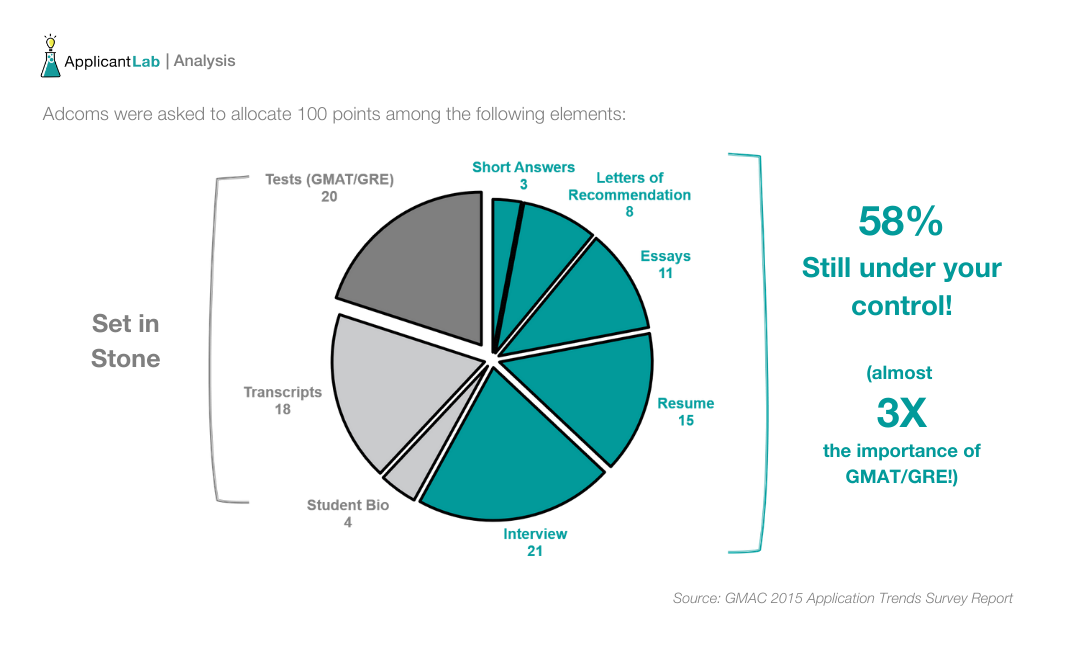
Explanation of the chart

I divided out the application elements into (relatively) “Fixed / quantitative” vs. things that are qualitative / more under your immediate control.

“Fixed / Quantitative” Things:

  • GMAT / GRE score (20 out of 100 points):
    • If you’ve already taken your standardized test, then this element is pretty much fixed. Yes, some people re-take and re-focus their study efforts and so are able to have dramatic score increases but at the AIGAC conference this year, we were told that usually after 3 tries most people don’t get a higher score. For that reason, I put this into the “fixed” category
    • If you haven’t taken your test yet, here’s a blog post I wrote with my top GMAT-test tips
  • G.P.A. (18 out of 100 points):
    • This is the MOST “fixed” element of your background. Unless you can build a time machine to re-do your college days, your G.P.A. isn’t changing. (There is detailed advice for how to mitigate low grades in the “Strengths and Weaknesses” module of ApplicantLab)
  • Student biography (4 points):
    • This refers to a candidate’s background elements: where they grew up, what their family is like, etc. Note that this plays a pretty small role in the admissions decision, but unusual facets of your biography might catch their attention.

“Non Fixed” Things:

So now let’s look at the elements that I grouped into the second batch: things that are still under your control. Devoting attention to the following can make a difference in the decision:


  • Interview (21 out of 100 points!):
    • This came in with a whopping 21 points, barely beating out the GMAT as the single most important element in the MBA application. Surprising? Read my analysis below.
  • Resume (15 points – MORE important than the essay??):
    • Wait, what? With all the hand-wringing around crafting a Nobel-prize winning essay, why did the 1-page resume get more points? (see below for why)
  • Essays (11 points, not 100 points!!!):
    • Essays are the 2nd most difficult part of the MBA application, according to a survey done by AIGAC. (The admissions consulting organization that I’m a member of). So: you still need help with essays (it can be very easy to screw them up), but you don’t need to lose so much sleep over them, since other parts of your application really, truly DO balance out.
  • Recommendations (8 points):
    • … almost as important as the essays themselves. Hmm.
  • “Short answer questions” (3 points):
    • This refers to the little text boxes in the application form that usually ask things like “Describe your job function” or “Describe your involvement with this extra-curricular activity”. They allow you to provide a bit more detail than what can usually fit in a resume.
    • Note: For certain schools, like Harvard, the short answer questions are actually incredibly important. Upgraded ApplicantLab users get a detailed analysis & video walk-throughs for why this part of the HBS application is so crucial, as well as advice for not just what to write in those short-answer boxes but how to write them.

Reiterating the MOST IMPORTANT TAKE-AWAY:

Before I move on to my analysis / explanation of what these things mean, let’s take a breath and examine the #1 thing you should take from these survey results:

The combined qualitative pieces of the application (essays, interview, resume, recommendations) are THREE TIMES MORE IMPORTANT than the GMAT / GRE score alone*.

So what does this mean for you?

Well, when we admissions consultants say that it IS possible for a strong application to overcome a less-than-perfect GMAT score or GPAwe really mean it!


*And ApplicantLab helps you with ALL those elements, on your own schedule, for less than the cost of ONE HOUR with a Traditional Consultant

Analysis / insights into what this means

1. The interview is the MOST important single element:

It’s not THAT much more important, but it IS very important.

Why? Because a candidate that is flawless on paper might be unimpressive – or worse, an insufferable jerk – in real life.

Similarly, a candidate that the AdComs weren’t sure of might have such a winning charisma and tight, solid answers to the interview questions that they can’t help but let them in.

2. The Resume is slightly more important than the essays:

So despite the sleepless nights and endless angst over essays, it turns out that the resume is a wee bit more important. While it’s not common knowledge, it does indeed make sense.

Think about it: and AdCom person HAS to read your resume first to understand the backdrop against which the stuff in your essays & recommendation happened.

The resume also provides a sense of your accomplishments over a long period of time, so they can see if you have a “habit of leadership”

For reasons I explain in the Lab, using the same resume you used for your last job-hunt is a huge blunder, especially given how important it is. If you want to know how to tailor a resume for business school applications the step-by-step resume module in ApplicantLab will guide through everything you need to know. In fact, some of the resume module is free right now!

3. The recommendations are almost as important as the essays:

It is obvious when an applicant simply spent a couple of minutes asking the recommenders: “So hey, just say something nice about me, ok? Thanks!”.

You need to put JUST as much thought into WHAT you’re going to request that your recommenders write about you vs. what you’re going to write about yourself.

The recommendations are the “sanity check” part of the application. And thank goodness for that, too…otherwise, we’d have a ton of dishonest people out there claiming to have single-handedly convinced Steve Jobs to launch an Apple-branded phone product (ha ha).

4. Note that they said “Transcript” and NOT “G.P.A.”:

If you read “what are my chances?” threads, people often put just a static GPA number, but that’s not admissions committees look at.

They look at the actual classes you took, they look at trends in your grades, not just the grades themselves. They look at whether you challenged yourself, and whether you focused on only one field or were more of a well-rounded Renaissance person.

If your GPA is on the lower side, you CAN do a number of things to counterbalance it. See the “Strengths and Weaknesses” module in ApplicantLab for advice that is specific to your situation.

Did any parts of this survey surprise you? Got any questions? If you’re wondering how to get world-class advice on assembling the THREE TIMES MORE IMPORTANT THAN THE GMAT qualitative elements of your application, on-demand and at an affordable price, ApplicantLab is here for you!


What Are The Most Important Parts Of Your MBA Application?
Maria |
December 14, 2020

Video transcript, for you skimmers out there: 

I love the fact that they. Report on this metric, right? The salary percentage increase, I think is an incredibly valuable metric because there are so many business schools out there that are great for so many people. And at the end of the day, these programs are in fact able to do what a lot of business school applicants are hoping for.

They are in fact able to provide a real change in the trajectory of someone’s career. They are, in fact, able to help people leapfrog. Into a higher career stratum than they would’ve otherwise been able to be in. So from that perspective, I love the fact that the FT reports on the salary percentage increase.

So valuable. I think it helps, when sometimes I talk to people at the beginning of the business school journey, I will frequently hear something like, well, it’s M seven or bust, you know, it’s Harvard, Stanford, Wharton, or bust.

And I’m often like, look, slow your roll, man. There are so many programs out there that are going to get you. They might not be the first ones that you think [00:01:00] of, but wow, does that even matter? I mean, whew. Look at some of these numbers. $170,000. That is nothing to sneeze at, especially if it’s one and a half times more than what you were making before business school.

I mean, wow. , That is life changing. , And these schools can really change people’s lives. And I think it’s important to have this metric available because I think it helps open people’s eyes. To, To be a little bit more open-minded. , And I think that’s wonderful.

Where my little quibble is. Is that I believe this is an important metric to report upon. However, I do not believe that it is a metric that should have significant amount of weight in the rankings because if we think about what is the purpose of a ranking, it is meant to be some sort of a representation of relative quality.

Now rankings. The entire concept of them is flawed the entire, for me, the entire concept of an ordinal ranking is ridiculous. Like school versus two versus four, versus seven versus six . You know, like, there, there’s sort of [00:02:00] these tiny miniature marginal differences. I think that school rankings should instead be in buckets.

Like, here is the top bucket, and then here is the also very good, but just underneath the top bucket, the next bucket. Um, but no one, no one listens to me. Uh, but so anyway, to the extent that a ranking. Is intended to be some sort of a measure of a program’s quality. I don’t think that this metric is one that should be included in the weighting.

Look, again, . Life-changing levels of improvements in salary. But when I look at, okay, so these were the top five programs by the salary percentage increase, but now when I look at it by the weighted salary, right, the top five US programs, by weighted salary, it’s not entirely accurate to say that.

Well, these programs, you start with people who have lower incoming salaries and they end up in the same place as the other programs. The numbers do not [00:03:00] really, , the numbers would tell a slightly different story. So if you look at the weighted salary a few years out for the top five programs by salary,

we’re talking about a $70,000 a year difference, roughly 240 a year versus 170 a year. That’s about a 40% difference, which I don’t think is a small, you know, if we were talking 5%, even 10%, I’d be like, yeah, 10%, that’s nothing. It’s, you know, nothing but 40% I do think is a pretty, I think it’s a pretty significant difference, uh, that is worth noting.

And so. Your point about like, well, they were letting in the people who were already on a, you know, if you were making, let’s see if we can, if we figure out, okay, so if we take this, these numbers, then we can sort of back into what’s an implied pre MBA salary, you know, that would indicate maybe something in the mid sixties before MBA versus, you know, one 10 something, [00:04:00] 1, 1 10, 1 15, for these other programs.

I get your argument. Your argument is like, look, these people were already clearly high achievers prior to business school, and so, mm-hmm. Is it not true then that the business school, like they would’ve continued to be high achievers And in fact, this is true, some of the most successful, financially successful people I know skipped business school altogether and they didn’t need it.

, However, I think GMAC often does, polls or surveys of MBA graduates, and I think the vast majority of them, at a minimum say that they’re glad that they went to business school, that they do feel that it was worth, their time. So. How much of this is,, nature versus nurture.

We, we will never know. , But I would gently push back on the fact that I, because these numbers essentially to the extent that they’re lower than say these numbers, it effectively penalizes thes e schools in this ranking. And for that reason, I don’t think that it should be part of the ranking because you’re penalizing a school for letting in more successful people.

But there’s a benefit. [00:05:00] To attending. Like, first of all, if you are a more successful person, think of the opportunity cost that you’re giving up. So the fact that these schools are able to lure away people to give up two years of their salary, in order to go to business school in the first place, I think is a pretty good indicator of the desirability or the perceived desirability of those programs.

Also, I do think that there is merit to thinking about like, who are my peers going to be in a business school? and. If a school is attracting people who were more successful prior to business school, I actually think that that is an indicator of the quality of the school, not only because it shows the people that are willing to give up those two years of salary, but also think about who the peer group is once someone is in the school.

Right? That means that if you are attending one of these schools. This percentage isn’t as high, but you’re surrounded by people who, prior to business school, were already achieving on a different level. And also after they graduate, they continue to achieve on a different level. True. The slope is not as sharp.

Right. But the.

[00:06:00] Result is a larger number. So I think that this implies that perhaps at the school itself, you might be surrounded by people who are driven. some people might say more competitive, which might not be everyone’s cup of tea, but people who are more driven and also after they graduate, they continue to be driven.

And so I think that also implies something pretty powerful about the ultimate benefit of the network because business school isn’t just the two years you go there and it’s not just that first job you get out of school or that third job you have five years out of school.

it’s also who’s your network gonna be and, and who are you gonna call 10, 15, 20 years after graduation? To invest in your company or to partner with your company or to start a company with. so I do think that there is value to attending a school and to have your peers during school and after school be people who were, for lack of a better term, high performers.

[00:07:00] I don’t think that this should be punished because I do think that this does yield a better business school. Experience and a better result in the long term. And so my quibble, again, I love this metric. I think this is an amazing metric to provide, but my quibble is that this should not be given honestly, any weight at all, and certainly not the high level of weight that it’s given, because again, you’re punishing the schools that, you know, you’re basically indicating that I, what I would say is an indication of quality.

An indirect indication of quality, but an indication of quality all the same. You’re basically punishing the schools that have sort of higher quality, quote unquote, coming in. And, and that to me is. Counterintuitive and kind of wrong. And so that’s why I continue to think that this should not be, uh, reported upon.

Absolutely. Tell us. It’s important. I think it’s great to know. I love using this information, but I don’t think it should be used in terms of like, let’s figure out which programs are the , [00:08:00] quote unquote highest quality programs. But what do you think? What did I miss? let me know. Thanks.

Maria

New around here? I’m an HBS graduate and a proud member (and former Board Member) of AIGAC. I considered opening a high-end boutique admissions consulting firm, but I wanted to make high-quality admissions advice accessible to all, so I “scaled myself” by creating ApplicantLab. ApplicantLab provides the SAME advice as high-end consultants at a much more affordable price. Read our rave reviews on GMATClub, and check out our free trial (no credit card required) today!