
MBA Admissions Committees Have Needs… Do You Meet Those Needs?
Maria |
October 12, 2022
There is a LOT OF HAND-WRINGING on a zillion MBA message boards from candidates anxious to know:

What are my chances of acceptance to the MBA program of my choice? My GPA is pretty low, so I’m super-nervous…“.

Frequently, messages like this are often accompanied by similar messages along the lines of:

I can’t believe I didn’t get accepted! I have a 780 GMAT and a 3.9 GPA …what went wrong?

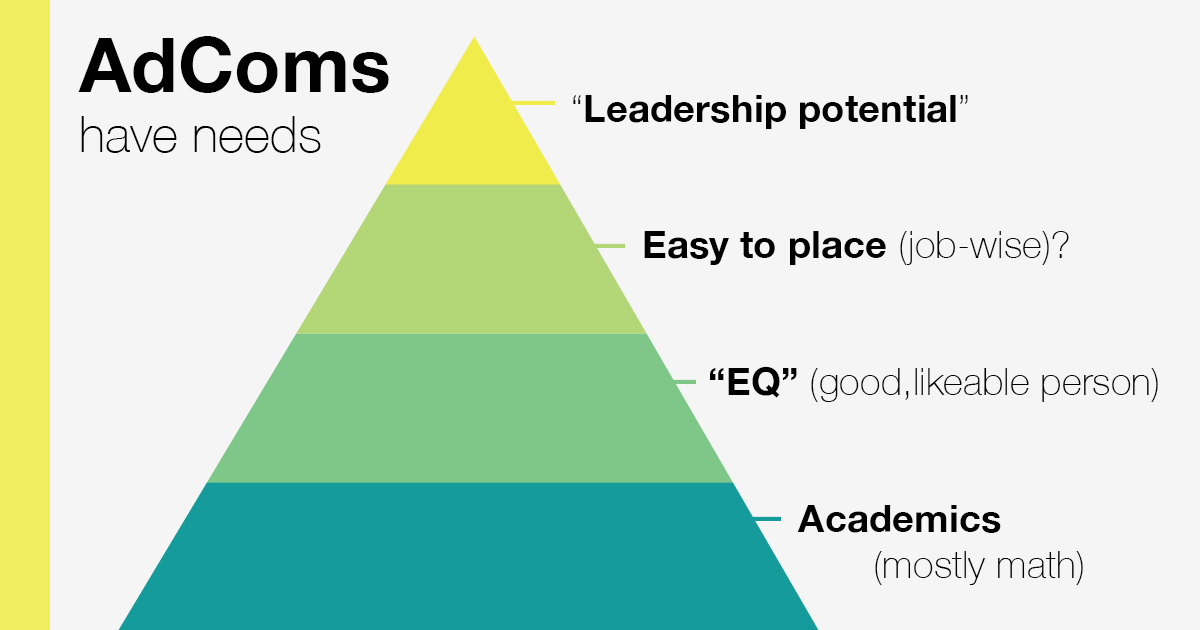
The answer to both of these questions might be found in a concept I call the “AdComs’ Hierarchy of Needs“.

Certain things (like academics) are a hurdle to be cleared. Just like in track and field, it doesn’t matter if you clear the hurdle by 1 mm or by a mile; it just matters that you clear it. Once you do that, then you need to move your way up the hierarchy of needs to gain admission.

The higher up the hierarchy you go, the more work it takes to “prove” it, and thus the bulk of your application should focus on the top of the “pyramid.”

In sum, a business school is ONLY as good as its reputation,

and its reputation is ONLY as good as the people it lets in

(since those are the alums that go out into the world and make a difference), 

and your GMAT / GRE score and GPA are only a small predictor of business success…

but your leadership style and past accomplishments are MUCH more relevant!

I made a video explaining the Hierarchy of Needs here:

To summarize the video:

– MBA Admissions Committees will have a first-glance, gut-check reaction to your profile, based upon certain major elements of your background (e.g. industry, GPA, etc.). If your background comes with any negative stereotypes (e.g. engineers are anti-social; people with low GPAs are stupid), then you need to work to counter those weaknesses in your profile (the entire strengths & weaknesses module of ApplicantLab does exactly that)

– Schools are not simply looking at academics: basic academics get your foot in the door, but a 790 GMAT from someone with a boring work profile will never, ever get in over someone with a 690 who has moved mountains.

Once you prove that you can handle the academics — well, that’s just the first step. THEN you need to prove:

Basic “EQ” / people skills  (do people like to work with you, or will you embarrass the school’s name later on?)

        • We’re increasingly seeing the stereotypical “evil boss” get called out: people are less-willing to work with those whom they don’t see as trust-worthy or kind. Abusive e-mails / videos of childish rants are easier than ever to go viral on social media. NO business school wants ITS name associated with the next damning “terrible boss” headline. And even before current social media trends… the world is a very small place. You never know when the junior employee you mis-treat today might be the hiring manager for a job you want in 15 years. I’ve seen some early-career high-fliers sort of crash and burn… by their own hand! They burned their own bridges… yikes.

Post-MBA employability (can you hold down a job, or will the corporate recruiters regret hiring you — which also reflects poorly upon a business school!)

        • An overwhelming majority of students (even those who hope to one day become entrepreneurs) first need to work at larger companies (to make larger paychecks, to pay off those very large student loans). An MBA applicant who seems to quit (or get fired from) their job every year, who can’t seem to hold down a job, who never seems to get promotions… well, that can be a scary signal to an admissions officer: “Will this person embarrass us with our corporate recruiters, or even worse, make these elite companies less-willing to hire our graduates?”

“Leadership potential” (an often-used term that we describe in detail in the ApplicantLab — we help you find your best leadership stories) (can we predict how likely it is that you’re going to go out and change the world, given where you’ve been in the past)

        • The more competitive the program you’re applying to, the higher the burden of proof is at the top of the pyramid. That is, Stanford and Harvard are hoping to identify each generation’s next great CEOs, whereas other great business schools might be OK with admitting people who are more “slow and steady” corporate climbers. So, how do we try to figure out where each candidate will end up in the long-term? Well, we look at their past accomplishments as a heavy guide.

And — once you prove the “basics” lower down in the pyramid (e.g., “Yes, I can handle the coursework”), then the other 3 factors will come more into play.

Academics simply make you “qualified” to attend;

EQ / Employability / Leadership is what separates acceptances from rejections,

And especially “Leadership” separates acceptances from the super-elite schools from the “still very good” schools.


I hope you found this concept useful. I often find that MBA message-board posts focus WAY too much on basic statistics like G.P.A. or GMAT / GRE — and while yes, there is a certain minimum threshold of a minimum GMAT / GRE score that will probably result in instant rejection (though now more and more schools are allowing people to apply with a standardized test waiver! So certain candidates with some specific backgrounds don’t even need to take the test!), GPA is subject to much more thoughtful consideration (that is, a 3.9 GPA in “Staring at Your Belly Button” studies from NoName Joke College will *NEVER* be as well-respected as, say, a 3.3 GPA in chemical engineering from MIT) , and as such, merely the raw number on its own doesn’t mean much in terms of predicting acceptance.

MBA Admissions Committees Have Needs… Do You Meet Those Needs?
Maria |
October 12, 2022

Video transcript, for you skimmers out there: 

I love the fact that they. Report on this metric, right? The salary percentage increase, I think is an incredibly valuable metric because there are so many business schools out there that are great for so many people. And at the end of the day, these programs are in fact able to do what a lot of business school applicants are hoping for.

They are in fact able to provide a real change in the trajectory of someone’s career. They are, in fact, able to help people leapfrog. Into a higher career stratum than they would’ve otherwise been able to be in. So from that perspective, I love the fact that the FT reports on the salary percentage increase.

So valuable. I think it helps, when sometimes I talk to people at the beginning of the business school journey, I will frequently hear something like, well, it’s M seven or bust, you know, it’s Harvard, Stanford, Wharton, or bust.

And I’m often like, look, slow your roll, man. There are so many programs out there that are going to get you. They might not be the first ones that you think [00:01:00] of, but wow, does that even matter? I mean, whew. Look at some of these numbers. $170,000. That is nothing to sneeze at, especially if it’s one and a half times more than what you were making before business school.

I mean, wow. , That is life changing. , And these schools can really change people’s lives. And I think it’s important to have this metric available because I think it helps open people’s eyes. To, To be a little bit more open-minded. , And I think that’s wonderful.

Where my little quibble is. Is that I believe this is an important metric to report upon. However, I do not believe that it is a metric that should have significant amount of weight in the rankings because if we think about what is the purpose of a ranking, it is meant to be some sort of a representation of relative quality.

Now rankings. The entire concept of them is flawed the entire, for me, the entire concept of an ordinal ranking is ridiculous. Like school versus two versus four, versus seven versus six . You know, like, there, there’s sort of [00:02:00] these tiny miniature marginal differences. I think that school rankings should instead be in buckets.

Like, here is the top bucket, and then here is the also very good, but just underneath the top bucket, the next bucket. Um, but no one, no one listens to me. Uh, but so anyway, to the extent that a ranking. Is intended to be some sort of a measure of a program’s quality. I don’t think that this metric is one that should be included in the weighting.

Look, again, . Life-changing levels of improvements in salary. But when I look at, okay, so these were the top five programs by the salary percentage increase, but now when I look at it by the weighted salary, right, the top five US programs, by weighted salary, it’s not entirely accurate to say that.

Well, these programs, you start with people who have lower incoming salaries and they end up in the same place as the other programs. The numbers do not [00:03:00] really, , the numbers would tell a slightly different story. So if you look at the weighted salary a few years out for the top five programs by salary,

we’re talking about a $70,000 a year difference, roughly 240 a year versus 170 a year. That’s about a 40% difference, which I don’t think is a small, you know, if we were talking 5%, even 10%, I’d be like, yeah, 10%, that’s nothing. It’s, you know, nothing but 40% I do think is a pretty, I think it’s a pretty significant difference, uh, that is worth noting.

And so. Your point about like, well, they were letting in the people who were already on a, you know, if you were making, let’s see if we can, if we figure out, okay, so if we take this, these numbers, then we can sort of back into what’s an implied pre MBA salary, you know, that would indicate maybe something in the mid sixties before MBA versus, you know, one 10 something, [00:04:00] 1, 1 10, 1 15, for these other programs.

I get your argument. Your argument is like, look, these people were already clearly high achievers prior to business school, and so, mm-hmm. Is it not true then that the business school, like they would’ve continued to be high achievers And in fact, this is true, some of the most successful, financially successful people I know skipped business school altogether and they didn’t need it.

, However, I think GMAC often does, polls or surveys of MBA graduates, and I think the vast majority of them, at a minimum say that they’re glad that they went to business school, that they do feel that it was worth, their time. So. How much of this is,, nature versus nurture.

We, we will never know. , But I would gently push back on the fact that I, because these numbers essentially to the extent that they’re lower than say these numbers, it effectively penalizes thes e schools in this ranking. And for that reason, I don’t think that it should be part of the ranking because you’re penalizing a school for letting in more successful people.

But there’s a benefit. [00:05:00] To attending. Like, first of all, if you are a more successful person, think of the opportunity cost that you’re giving up. So the fact that these schools are able to lure away people to give up two years of their salary, in order to go to business school in the first place, I think is a pretty good indicator of the desirability or the perceived desirability of those programs.

Also, I do think that there is merit to thinking about like, who are my peers going to be in a business school? and. If a school is attracting people who were more successful prior to business school, I actually think that that is an indicator of the quality of the school, not only because it shows the people that are willing to give up those two years of salary, but also think about who the peer group is once someone is in the school.

Right? That means that if you are attending one of these schools. This percentage isn’t as high, but you’re surrounded by people who, prior to business school, were already achieving on a different level. And also after they graduate, they continue to achieve on a different level. True. The slope is not as sharp.

Right. But the.

[00:06:00] Result is a larger number. So I think that this implies that perhaps at the school itself, you might be surrounded by people who are driven. some people might say more competitive, which might not be everyone’s cup of tea, but people who are more driven and also after they graduate, they continue to be driven.

And so I think that also implies something pretty powerful about the ultimate benefit of the network because business school isn’t just the two years you go there and it’s not just that first job you get out of school or that third job you have five years out of school.

it’s also who’s your network gonna be and, and who are you gonna call 10, 15, 20 years after graduation? To invest in your company or to partner with your company or to start a company with. so I do think that there is value to attending a school and to have your peers during school and after school be people who were, for lack of a better term, high performers.

[00:07:00] I don’t think that this should be punished because I do think that this does yield a better business school. Experience and a better result in the long term. And so my quibble, again, I love this metric. I think this is an amazing metric to provide, but my quibble is that this should not be given honestly, any weight at all, and certainly not the high level of weight that it’s given, because again, you’re punishing the schools that, you know, you’re basically indicating that I, what I would say is an indication of quality.

An indirect indication of quality, but an indication of quality all the same. You’re basically punishing the schools that have sort of higher quality, quote unquote, coming in. And, and that to me is. Counterintuitive and kind of wrong. And so that’s why I continue to think that this should not be, uh, reported upon.

Absolutely. Tell us. It’s important. I think it’s great to know. I love using this information, but I don’t think it should be used in terms of like, let’s figure out which programs are the , [00:08:00] quote unquote highest quality programs. But what do you think? What did I miss? let me know. Thanks.

Maria

New around here? I’m an HBS graduate and a proud member (and former Board Member) of AIGAC. I considered opening a high-end boutique admissions consulting firm, but I wanted to make high-quality admissions advice accessible to all, so I “scaled myself” by creating ApplicantLab. ApplicantLab provides the SAME advice as high-end consultants at a much more affordable price. Read our rave reviews on GMATClub, and check out our free trial (no credit card required) today!