
Are you too young for an MBA? Advice for Younger Applicants
Maria |
June 1, 2020

How young is too young to apply to top MBA programs? 

We get asked this question a lot. Thanks to COVID-19 and the general mess of the world economy, we are now getting asked this question daily.

The Data: How Old is the Typical MBA Student?
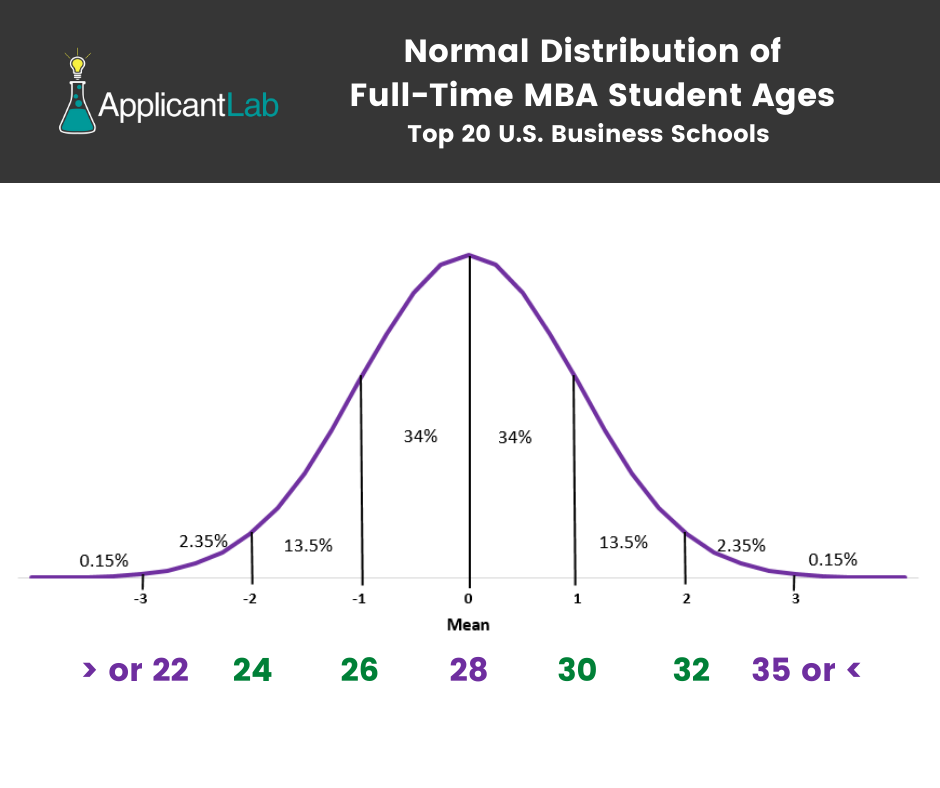
Normal Distribution of Full Time MBA Student Ages

Get ready to see this again in your CORE Stats class.


If you are 24 or younger, the odds aren’t in your favor. This analysis by MBA Data Guru, while unscientific, shows that many business schools penalize people that are just a bit too young. 

That is not to say that we haven’t seen ApplicantLab users 24 and younger get admitted. However, similar to those admitted with lower GMAT scores, these candidates demonstrate leadership and initiative that goes far beyond their years of work experience. View ApplicantLab success stories. 


“As a fringe candidate that was considered too inexperienced (2 years out of college), too young (24), and probably too dumb (2.9 GPA), I needed every ounce of help I could to craft a cohesive and persuasive story for my MBA applications. Without the ApplicantLab setup and [Maria’s] personal help, I probably don’t receive a single acceptance. 3 acceptances later, including the Tepper School at CMU, I want to thank you a hundred times over for setting up a fantastic, intuitive, and most importantly, effective tool for MBA applications. – HUDAMANIAM 


What Business Schools Are Looking For In Younger Candidates 

Younger candidates accepted to top business schools* almost always fit the following criteria: 

  • Have at least two years of work experience.
  • Have demonstrated significant work and leadership experience post-college (Note: You don’t need to have been in charge of people, but you should have demonstrated ownership of an important project or initiative.) 
  • Have interesting or impressive work experience (entrepreneurship, a top consulting firm, Google, a major non-profit, etc.) 
  • Have a bulletproof rationale for “Why an MBA” and “Why Now”. 
  • Have a unique well-researched career vision that is possible given they have less work experience (Travel, Food, Social Impact, etc.) 


*Note: We do not include early application programs like Harvard’s 2+2 program in our analysis.


MBA Recruiting as a Younger Candidate 

The last bullet is particularly important. If you have less than three years of work experience, you could find yourself at a significant disadvantage during MBA recruiting. 


Believe it or not, many companies that recruit MBAs on campus require between 3 – 5 years of work experience for their MBA internships and rotational programs. This can put younger MBA students at a significant disadvantage in recruiting in comparison to their peers. If you are pursuing a Brand Management, Consulting, or General Management career, it may be worth waiting to gain additional years of work experience to have a more competitive profile for recruitment. 


Should You Wait? 

As one AdCom put it: “Why are they in such a hurry…especially, why are then in such a hurry to hear ‘no’?”


In general, if you have less than three years of work experience and don’t fit the criteria above, you should probably wait to apply to business school. 


This is especially true if you: 

  • If you majored in business in undergrad, since you were studying this stuff a year or two ago. 
  • Could benefit from additional experiences in the next year that will fill gaps in your profile (teamwork, international experience, etc.) 
  • Have less than two years of work experience (basically the minimum requirement) 


The one exception is if you are in a pre-defined pre-MBA / rotational program (e.g., 2-year Analyst program in banking/consulting, or a rotational program at a company). You have to make a decision. You could decide to apply to business school now. However, you could also take the increasingly common third Analyst year or get a job in an industry of interest (P.E., Tech, etc.). 


Likewise, if you hate your current job, we would encourage you to make a career move that will get you closer to your career goals. Then, you can apply to business school in 2 years with a strong rational and profile. Not to mention, you will have a more competitive profile for MBA recruitment. 


Benefits of Waiting 

  1. COVID-19 has impacted MBA recruitment. Why go to business school and compete with students who have many more years of experience than you when there are fewer roles? 
  2. You will have a stronger story and profile, which could help you gain additional scholarships and fellowship opportunities. 
  3. You’ll have additional stories and knowledge to share with classmates. This may help you get more out of the MBA experience. 


Conclusion 

Not convinced? We are happy to help you make a decision about when to apply!

Existing ApplicantLab users can book a Sanity Check where we can speak 1:1 on your MAB admissions chances. We also provide support and advice for Younger Applicants within the ApplicantLab platform. In fact, we’ve helped many younger applicants make it into their dream schools.

Sign up for free trial and discover our advice for maximizing your admissions chances no matter your age or years of work experience.


“I’m heading to Wharton this Fall – the ApplicantLab was the secret sauce that got me in. (In fact, Maria’s/the Lab’s advice “let’s not bury the lead” has played out right here!

For context – I’m an Indian male engineering – a special snowflake – just like everyone else. Additionally, my number of years of work experience was relatively “light” when compared to the rest of the cohort and the company I work for usually begs the question, “Where do you work, again?” By the way, did I mention that my GMAT score was slightly below school averages, and way below standards for engineers from India?” – AJINK25


Are you too young for an MBA? Advice for Younger Applicants
Maria |
June 1, 2020

Video transcript, for you skimmers out there: 

I love the fact that they. Report on this metric, right? The salary percentage increase, I think is an incredibly valuable metric because there are so many business schools out there that are great for so many people. And at the end of the day, these programs are in fact able to do what a lot of business school applicants are hoping for.

They are in fact able to provide a real change in the trajectory of someone’s career. They are, in fact, able to help people leapfrog. Into a higher career stratum than they would’ve otherwise been able to be in. So from that perspective, I love the fact that the FT reports on the salary percentage increase.

So valuable. I think it helps, when sometimes I talk to people at the beginning of the business school journey, I will frequently hear something like, well, it’s M seven or bust, you know, it’s Harvard, Stanford, Wharton, or bust.

And I’m often like, look, slow your roll, man. There are so many programs out there that are going to get you. They might not be the first ones that you think [00:01:00] of, but wow, does that even matter? I mean, whew. Look at some of these numbers. $170,000. That is nothing to sneeze at, especially if it’s one and a half times more than what you were making before business school.

I mean, wow. , That is life changing. , And these schools can really change people’s lives. And I think it’s important to have this metric available because I think it helps open people’s eyes. To, To be a little bit more open-minded. , And I think that’s wonderful.

Where my little quibble is. Is that I believe this is an important metric to report upon. However, I do not believe that it is a metric that should have significant amount of weight in the rankings because if we think about what is the purpose of a ranking, it is meant to be some sort of a representation of relative quality.

Now rankings. The entire concept of them is flawed the entire, for me, the entire concept of an ordinal ranking is ridiculous. Like school versus two versus four, versus seven versus six . You know, like, there, there’s sort of [00:02:00] these tiny miniature marginal differences. I think that school rankings should instead be in buckets.

Like, here is the top bucket, and then here is the also very good, but just underneath the top bucket, the next bucket. Um, but no one, no one listens to me. Uh, but so anyway, to the extent that a ranking. Is intended to be some sort of a measure of a program’s quality. I don’t think that this metric is one that should be included in the weighting.

Look, again, . Life-changing levels of improvements in salary. But when I look at, okay, so these were the top five programs by the salary percentage increase, but now when I look at it by the weighted salary, right, the top five US programs, by weighted salary, it’s not entirely accurate to say that.

Well, these programs, you start with people who have lower incoming salaries and they end up in the same place as the other programs. The numbers do not [00:03:00] really, , the numbers would tell a slightly different story. So if you look at the weighted salary a few years out for the top five programs by salary,

we’re talking about a $70,000 a year difference, roughly 240 a year versus 170 a year. That’s about a 40% difference, which I don’t think is a small, you know, if we were talking 5%, even 10%, I’d be like, yeah, 10%, that’s nothing. It’s, you know, nothing but 40% I do think is a pretty, I think it’s a pretty significant difference, uh, that is worth noting.

And so. Your point about like, well, they were letting in the people who were already on a, you know, if you were making, let’s see if we can, if we figure out, okay, so if we take this, these numbers, then we can sort of back into what’s an implied pre MBA salary, you know, that would indicate maybe something in the mid sixties before MBA versus, you know, one 10 something, [00:04:00] 1, 1 10, 1 15, for these other programs.

I get your argument. Your argument is like, look, these people were already clearly high achievers prior to business school, and so, mm-hmm. Is it not true then that the business school, like they would’ve continued to be high achievers And in fact, this is true, some of the most successful, financially successful people I know skipped business school altogether and they didn’t need it.

, However, I think GMAC often does, polls or surveys of MBA graduates, and I think the vast majority of them, at a minimum say that they’re glad that they went to business school, that they do feel that it was worth, their time. So. How much of this is,, nature versus nurture.

We, we will never know. , But I would gently push back on the fact that I, because these numbers essentially to the extent that they’re lower than say these numbers, it effectively penalizes thes e schools in this ranking. And for that reason, I don’t think that it should be part of the ranking because you’re penalizing a school for letting in more successful people.

But there’s a benefit. [00:05:00] To attending. Like, first of all, if you are a more successful person, think of the opportunity cost that you’re giving up. So the fact that these schools are able to lure away people to give up two years of their salary, in order to go to business school in the first place, I think is a pretty good indicator of the desirability or the perceived desirability of those programs.

Also, I do think that there is merit to thinking about like, who are my peers going to be in a business school? and. If a school is attracting people who were more successful prior to business school, I actually think that that is an indicator of the quality of the school, not only because it shows the people that are willing to give up those two years of salary, but also think about who the peer group is once someone is in the school.

Right? That means that if you are attending one of these schools. This percentage isn’t as high, but you’re surrounded by people who, prior to business school, were already achieving on a different level. And also after they graduate, they continue to achieve on a different level. True. The slope is not as sharp.

Right. But the.

[00:06:00] Result is a larger number. So I think that this implies that perhaps at the school itself, you might be surrounded by people who are driven. some people might say more competitive, which might not be everyone’s cup of tea, but people who are more driven and also after they graduate, they continue to be driven.

And so I think that also implies something pretty powerful about the ultimate benefit of the network because business school isn’t just the two years you go there and it’s not just that first job you get out of school or that third job you have five years out of school.

it’s also who’s your network gonna be and, and who are you gonna call 10, 15, 20 years after graduation? To invest in your company or to partner with your company or to start a company with. so I do think that there is value to attending a school and to have your peers during school and after school be people who were, for lack of a better term, high performers.

[00:07:00] I don’t think that this should be punished because I do think that this does yield a better business school. Experience and a better result in the long term. And so my quibble, again, I love this metric. I think this is an amazing metric to provide, but my quibble is that this should not be given honestly, any weight at all, and certainly not the high level of weight that it’s given, because again, you’re punishing the schools that, you know, you’re basically indicating that I, what I would say is an indication of quality.

An indirect indication of quality, but an indication of quality all the same. You’re basically punishing the schools that have sort of higher quality, quote unquote, coming in. And, and that to me is. Counterintuitive and kind of wrong. And so that’s why I continue to think that this should not be, uh, reported upon.

Absolutely. Tell us. It’s important. I think it’s great to know. I love using this information, but I don’t think it should be used in terms of like, let’s figure out which programs are the , [00:08:00] quote unquote highest quality programs. But what do you think? What did I miss? let me know. Thanks.

Maria

New around here? I’m an HBS graduate and a proud member (and former Board Member) of AIGAC. I considered opening a high-end boutique admissions consulting firm, but I wanted to make high-quality admissions advice accessible to all, so I “scaled myself” by creating ApplicantLab. ApplicantLab provides the SAME advice as high-end consultants at a much more affordable price. Read our rave reviews on GMATClub, and check out our free trial (no credit card required) today!